

This Month’s Blog post was written by Rem Martin (They/them), Charlotte Trans Healths’ Spring 2025 post-baccalaureate intern.
Accessibility Awareness
May 15th is Accessibility Awareness day, which aims to prompt conversation and action about the digital, physical, and societal barriers disabled people face. In observance of this day, take time to reflect on your clinical practice and consider it’s responsiveness to the needs of people with disabilities.
Taking a disability friendly approach to care:
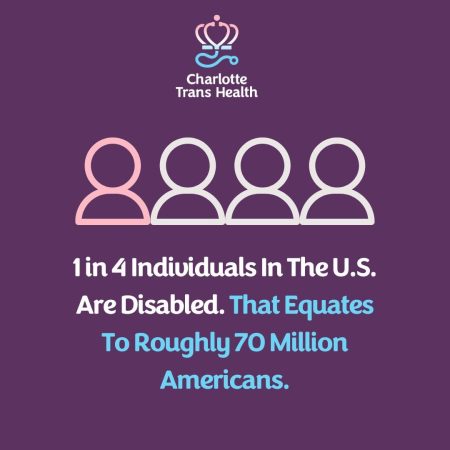
Providers work hard to ensure that their practices are safe and affirming for their clients; however, the needs of people with disabilities are often overlooked. Over a fourth (¼) of the U.S. population experiences some manner of disability, and yet accessibility and accommodation are seldom discussed in both business and healthcare settings (ADA, 2025). With transgender and gender diverse individuals experiencing an almost doubled likelihood of being disabled, it is important for providers to ensure their practices are accommodating(Smith-Johnson, 2022; CDC).
What is a Disability?
The CDC defines a disability as “a physical or mental impairment that greatly limits one or more major life activities including eating, breathing, walking, working, or taking care of oneself.” This includes both visible impairments, such as cerebral palsy and paralysis, and invisible impairments such as depression and chronic pain. It is important to recognize that not all disabilities are ‘obvious’ and that accommodation requests are open to anyone—those with disabilities are not required to disclose information about their impairments to be accommodated (NAMI, 2024).
ADA: What is it?
The Americans with Disabilities Act (ADA) is a federal civil rights law that prohibits discrimination against individuals with disabilities in various aspects of public life, including all healthcare services. This means that providers should ensure they meet the following standards:
Physical Accessibility: Ensure that medical facilities are accessible to individuals with mobility disabilities. This includes providing features such as accessible parking, entrances, restrooms, and examination rooms (Keller, 2022).
Auxiliary Aids and Services: Provide necessary aids and services, such as sign language interpreters, large print materials, or assistive listening devices, to ensure effective communication with patients who have hearing, vision, or speech disabilities (ADA, 2025).
Identifying Barriers: Understand healthcare disparities and barriers, including attitudinal, social, and physical obstacles, that hinder access to care for individuals with disabilities. This includes examining one’s own internalized stigmas and perceptions of those with disabilities and how it may be impacting their delivery of affirming care (Sinha et al., 2024).
Provider Accessibility Checklist:
Here are some questions providers can ask themselves in order to create a more accessible and inclusive environment:
- Is my practice wheelchair accessible?
- Does my practice website include alternative text or image descriptions? Is my website compatible with screen readers for visually impaired people?
- Do I have access to an ASL interpreter?
- Do I have closed captions for virtual meetings?
- Am I well-versed on ADA regulations regarding mobility aids and service animals?
- Does my practice have accessible bathrooms? (doorways large enough for wheelchairs and lowered sinks)
- Do I have access to braille resources for clients?
- Have I completed a Disability Competence training or consulted with disability advocates?
- Am I willing to make modifications to my services to accommodate individual needs?
- Does my approach to care consider the additional hardships and mental/emotional strains of those living with disabilities that are heavily stigmatized in our society?
Don’t be vague about your accommodations! Being an inclusive provider starts with being an ally! Providers who stay up to date on disability rights and advocacy work demonstrate to their patients that they are staunchly committed to creating an inclusive atmosphere for everyone!
Disability Support & Learning Resources
- USA.gov Disability Services
- NC Department of Health and Human Services- Disability Services
- Disability Rights and Resources
- Supporting the Dignity of Disabled People: Things to Know and Do
- 5 Simple Ways to Empower a Person with a Disability
- People First: A Guide to Interacting with People with Disabilities
- Working with Clients with Disabilities – Society for Psychotherapy
- Disability-Related Counseling Competencies
References
Americans with Disabilities Act, (ADA). (2025). Introduction to the Americans with Disabilities Act. ADA.Gov. https://www.ada.gov/topics/intro-to-ada/
Centers for Disease Control and Prevention, (CDC). (2024). Celebrating the Americans with Disabilities Act: Improving Health for All. Minority Health. https://www.cdc.gov/minority-health/features/disability-inclusion-as-a-cornerstone-for-health-equity.html
Keller, M. (2022). Doctors and Disability: Improving Inclusion in Medical Education. HCA Healthcare Journal of Medicine, 3(3). https://doi.org/10.36518/2689-0216.1393
Molina Healthcare. (n.d.). Disability Awareness & Sensitivity. https://www.molinahealthcare.com/~/media/Molina/PublicWebsite/PDF/providers/tx/Duals/disability-awareness.pdf
National Alliance on Mental Illness, (NAMI). (2024). People with Disabilities. https://www.nami.org/your-journey/identity-and-cultural-dimensions/people-with-disabilities/
Parish, A., Sinha, T., Harada, C. N., & Brooks, W. S. (2024). 12 Tips for Including Disability Awareness within Undergraduate Medical Education Curricula. MedEdPublish. https://mededpublish.org/articles/14-32/v3
Smith-Johnson, M. (2022). Transgender Adults Have Higher Rates Of Disability Than Their Cisgender Counterparts. Health Affairs, 41(10), 1470–1476. https://doi.org/10.1377/hlthaff.2022.00500